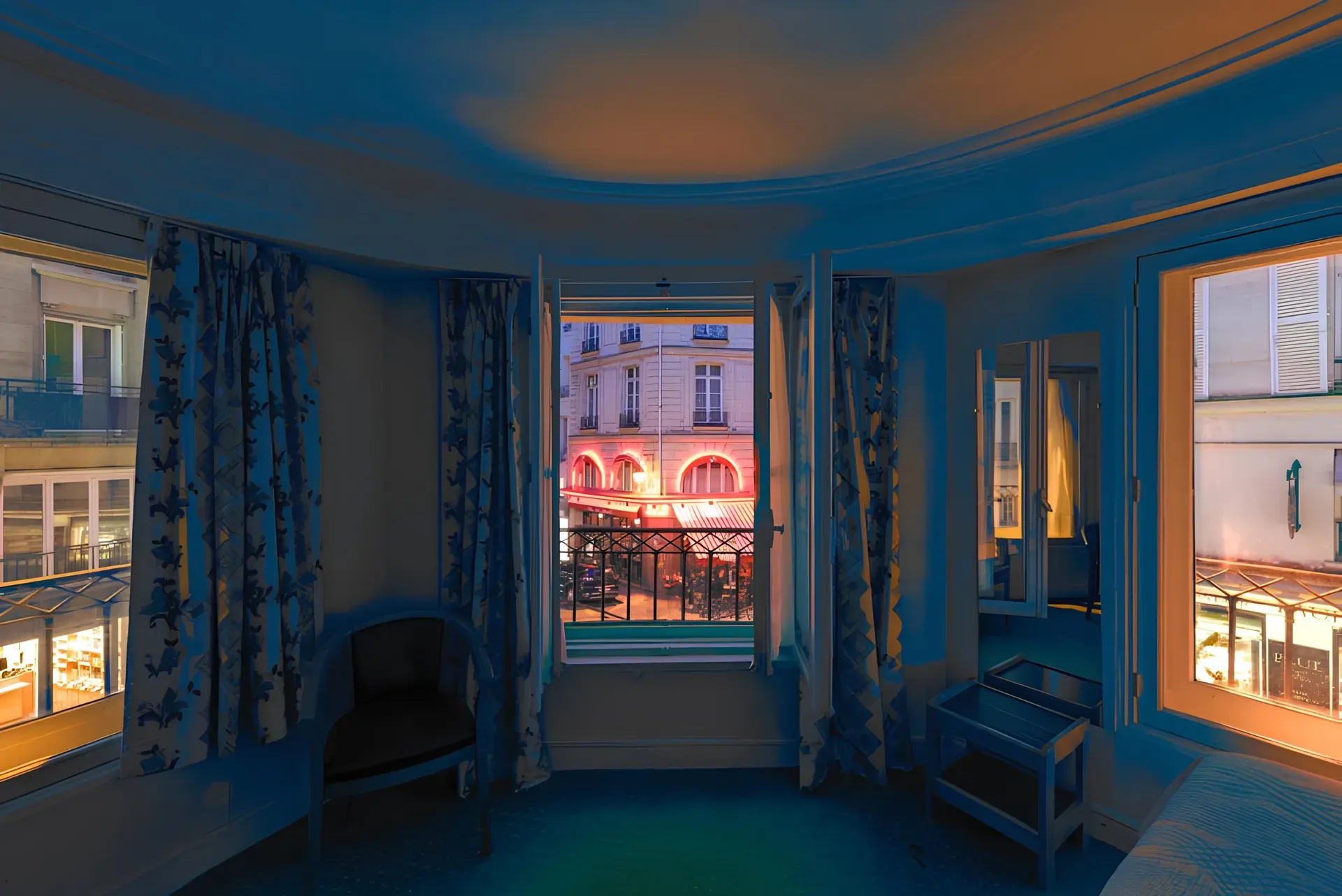
SINCE 1823
Our History
Two centuries of art, jazz and freedom in the heart of Saint-Germain-des-Prés.
Two centuries of art, jazz and freedom in the heart of Saint-Germain-des-Prés.
Founded by a former colonel of Napoleon I
Acquired by the Blanchot family, beginning of the artistic tradition
Headquarters of existentialists with Sartre and Beauvoir
Golden age of jazz and rock with Miles Davis and Jim Morrison
Albert Cossery resided here for 57 years
Restoration and rehabilitation by the Blanchot family
Through its maze of corridors, described as 'psychedelic' by Quentin Tarantino, time seems to glide over Hotel La Louisiane as it does over the oldest bell tower in Paris, watching from the roof of the Saint-Germain-des-Prés basilica. Off the beaten track, guaranteeing a family atmosphere, Hotel La Louisiane is proud to still be a haven for those who create or seek, writers or musicians, artists or researchers, international decision-makers or entrepreneurs, journalists or tourists, travelers from anywhere or from Paris.
Hotel La Louisiane is located exactly in the center of Saint-Germain-des-Prés, at the intersection of rue de Seine and rue de Buci, just a few minutes' walk from the Louvre Museum, the Musée d'Orsay, the Monnaie de Paris, the Delacroix Museum and the Luxembourg Gardens.
In 1815, a colonel of Emperor Napoleon I's cuirassiers refused the return of the Bourbon kings. After his last charges at Waterloo, he rebuilt his fortune in New Orleans. He returned to France in 1823 after the Emperor's death, which occurred while these French Louisianans wanted to free him by boarding Saint Helena Island. Moved by his former brothers in arms, heroes of a hundred campaigns and a thousand battlefields but often homeless, he founded the hotel, La Louisiane, in honor of this American land discovered in April 1682 and named after King Louis XIV by Robert Cavelier de La Salle, which the Emperor had ceded to the young United States in 1803.
Never had any of my shelters come so close to my dreams; I considered staying there until the end of my days.
— Simone de Beauvoir
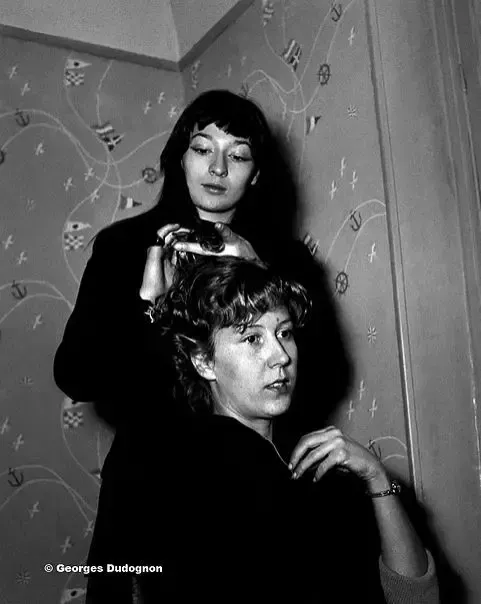
Like the Chelsea Hotel, Hotel La Louisiane - still the family hotel in the heart of Saint-Germain-des-Prés - has its memory, kept by the same family for four generations. At the time of Liberation and the return of Americans to Paris, it became the rallying point for jazz musicians. Muse of Saint-Germain-des-Prés, singer Juliette Gréco shared her room with Anabelle Buffet and Anne-Marie Casalis, Mouloudji met Boris Vian there.
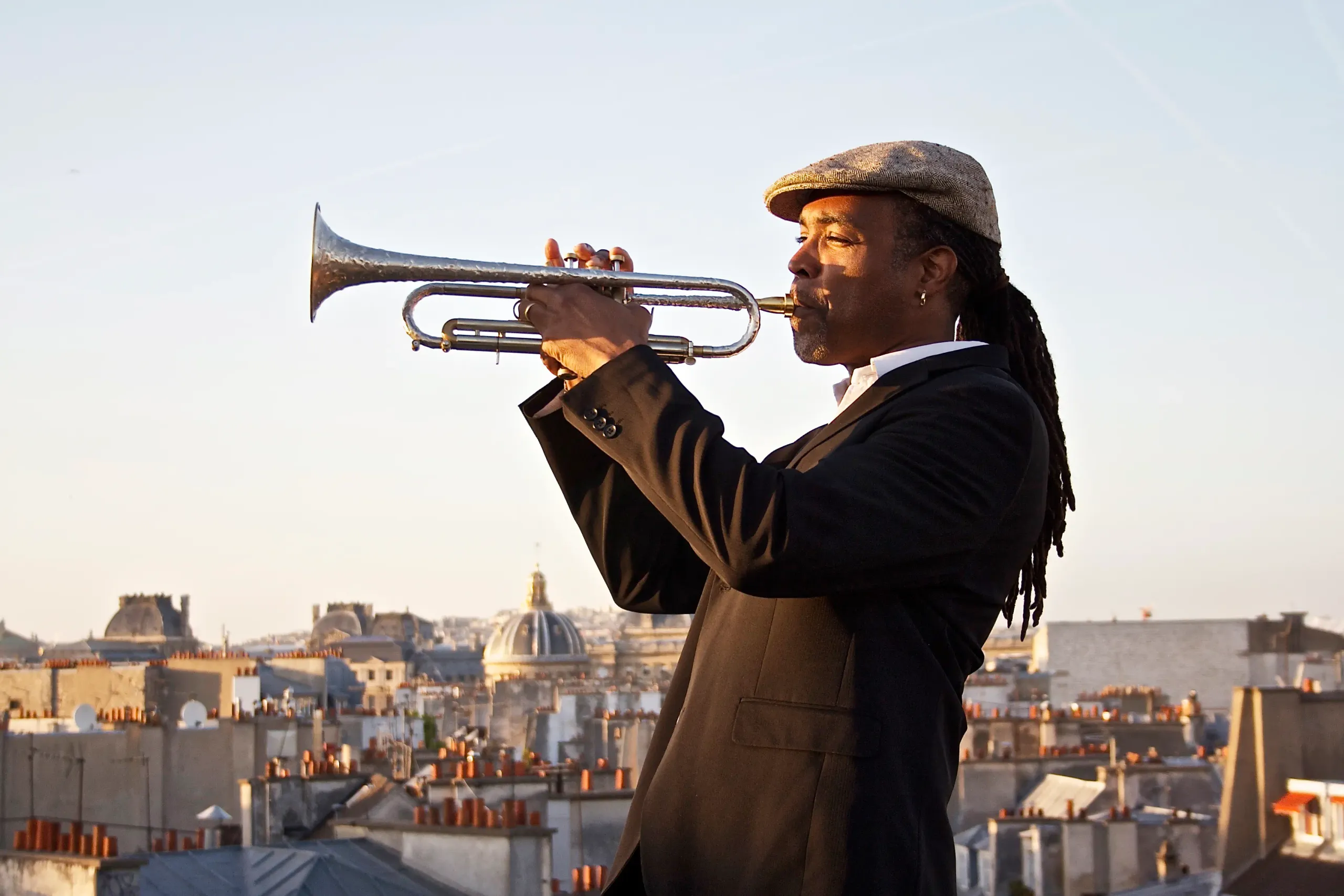
The great American jazzmen would meet there for jam sessions - Miles Davis, John Coltrane, Bud Powell, Lester Young, Chet Baker, Mal Waldron, Archie Shepp, Charlie Parker, Dexter Gordon, Ben Sidran, Wayne Shorter; then came their rock heirs, including Jim Morrison and The Doors musicians Ray Manzarek, John Densmore, Robby Krieger; then Pink Floyd - Roger Waters, David Gilmour, Rick Wright, Nick Mason...
A respectful servant of fine literature like all of Saint-Germain-des-Prés, Hotel La Louisiane is a "literary hotel", a label confirmed by Nathalie De Saint Phalle. Writers have always found inspiration here. Albert Cossery, a modern Aesop, has lived here since Liberation. Perhaps he sometimes thinks of his famous past roommates - Ernest Hemingway, Antoine de Saint-Exupéry, Henry Miller, Cyril Connolly, Gérard Oberlé, Peter Berling, Harvey Goldberg, Albertine Sarrazin, and especially the founding couple of Existentialism, Jean-Paul Sartre and Simone de Beauvoir.
Jean-Paul Sartre was also a man of theater, like other talented playwrights who came here seeking inspiration - Robert Wilson, Olivier Py, Robert Lepage... From the 1950s came film enthusiasts, directors Louis Malle, Bertrand Tavernier - who made Hotel La Louisiane the setting for Round Midnight, Alain Tanner, Leos Carax, Benoît Jacquot, Pépé Danquart, Barbet Schroeder for the filming of More, Quentin Tarantino, Michael Shamberg, Sally Potter, actors and actresses Mimsy Farmer, Klaus Grunberg, Klaus Kinski, Heinz Egelman, Jane Campion...
Between the wars, in his room at the Louisiane hotel, Cyril Connolly raised ferrets for which he sourced bloody liver from the horse butcher, ferrets that chased oranges, eggs and ping-pong balls, and wore harnesses adorned with bells.
— Read in Libération
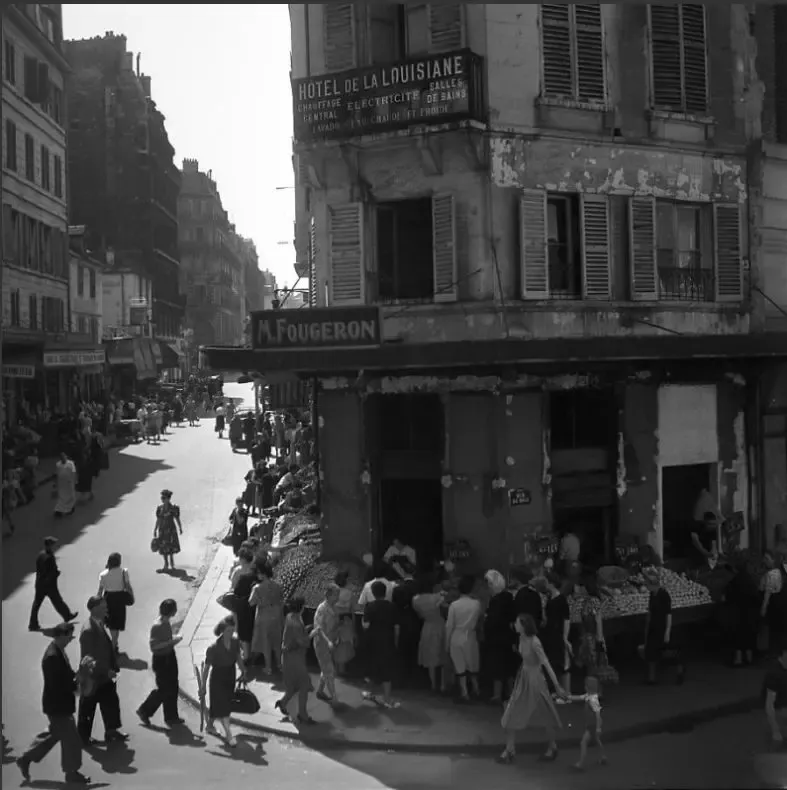
In autumn 1943, Simone de Beauvoir obtained a room at Hotel de la Louisiane, 60 rue de Seine, on the recommendation of Flore regulars, many of whom lived there. Sartre took one too, on the same floor. This time they were settled in Saint-Germain-des-Prés. Almost all members of the 'family' had followed them to their hotel. Mouloudji and his companion Lola had joined them.
The first floor of the Flore then took on the appearance of a very studious classroom. Everyone wrote, each at their small table: Simone de Beauvoir, "All Men Are Mortal"; Sartre, "The Roads to Freedom"; Jacques-Laurent Bost, "The Last of the Trades"; Mouloudji, "Enrico"; and Scipion, "Lend Me Your Pen", his collection of pastiches.
In 1945, an Egyptian writer arrived in Paris, in the land of the language he could read and write: Albert Cossery, who had no other desire than to possess young, pretty girls. He settled in furnished lodgings in Montparnasse, but the back-and-forth from Saint-Germain to his room with seduced young ladies proved tedious and repetitive. He moved to La Louisiane in 1951. He wrote there when he was truly bored, when there was really nothing better to do... The pleasure of living came before that of writing, which wasn't one. He owned nothing and lazed about...
"Laziness must be earned... The others, if they love work, well let them continue," he said cynically philosophically... "Not laziness in the sense of doing nothing, but of reflecting, and reading... The most extraordinary thing in the world is reading..."
In this sense, Cossery, difficult, elegant, rightfully suspicious, has lived at La Louisiane for forty years. He has only changed rooms once, and the one he occupies today remains extremely bare. He has kept only a few books (the best ones and his own) and clothes (wardrobes and suitcases full), but no objects (not even the small sculpted woman Giacometti had given him). A marginal Cairene who became a marginal Parisian.
Different times, different customs. After the Mistral, it's at La Louisiane that Sartre took refuge from 1943 to 1946 to write in the warmth. It's said he liked the street noise and had his newspaper delivered directly through the window of his room on the first floor. In the heart of Saint-Germain-des-Prés, at the Buci crossroads, the hotel, founded in 1886 by a colonel of Napoleon, goes relatively unnoticed. But admirers of the writer or jazz enthusiasts know its address.
— Isabelle Spaak, "These cult hotels of bohemian Paris", VSD, 2003
Saint-Germain-des-Prés has not only inspired writers or musicians; the effervescent creativity there attracts many artists, painters, sculptors or visual artists, performers or designers. Thus Hotel La Louisiane was also a meeting place for contemporary artists - Salvador Dalí with Amanda Lear, Bernard Buffet, Alberto Giacometti, Vassilakis Takis, Keith Haring, Dennis Oppenheim, Nam June Paik, Joseph Beuys, Lucian Freud, Benjamin Vautier, Cy Twombly, Eva & Adele, James Lee Byars...
Hotel La Louisiane has always supported artists and has thus invited many contemporary art creators to exhibit their works within its walls: Wang Du, G-Wen, Régine Kolle, Barthélémy Togo, Lionel Scoccimaro, Pascale Marthine Tayou, Chen Chieh-Jen, Julien Beneyton, Pascal Gilberti, Emmanuelle Villard, Franck and Olivier Turpin, Nicole Tran Ba Vang, Guillaume Paris, François Paire, Aimé Ntakayica, Liu Ming, Philippe Mayaux, Cécile Mathieu, Eric Le Maire, Patrick Lebret, Suzanne Junker, Yann Delacour, Gaston Damag, Jean-Luc Bichau, Pascal Bernier...
Anne-Marie Cazalis moved into Hotel de la Louisiane, sharing "for some time with Gréco the room that Sartre had rented during the Occupation. It was a round room at the corner of rue de Seine and rue de Buci. Next to it was an apprentice room where Sartre stored his bicycle, but which had been converted into a bathroom. Large red plush curtains hung at the windows. It was a theater set."
When the favorable outcome of the war seemed credible, Simone de Beauvoir and Sartre participated in festive evenings that the curfew requirements made last until dawn. Michel Leiris called them "fiestas". The Spanish expression emphasizes a deliberate will to party, despite everything.
Hotel La Louisiane has also become a meeting place for Internet entrepreneurs - the webpreneurs - and web professionals, especially those in online content industries, cultural, artistic or literary, in the purest tradition of a neighborhood where renowned publishers are established.
Hotel La Louisiane is built on the former enclosure of Saint-Germain-des-Prés abbey. The church of Saint-Germain-des-Prés was built in 557 by Germain, Bishop of Paris, canonized and celebrated on May 28, whose tomb it is. The first kings of France, of the Merovingian dynasty - that of the great Frankish king Clovis - are buried there.
Under the fortified towers, ancestors of the hotel, flows a river, toward the Seine, from which rue de Seine takes its name; the dreamlike virtues of this now underground water would explain our guests' happy sleep! When urbanization and Baron Haussmann's time came, Victor Hugo saved the church, the oldest in Paris, restored by Baltard. A Picasso drawing there pays tribute to the poet Guillaume Apollinaire.
However short its existence may have been, the true Saint-Germain-des-Prés has remained in memory as a place of great tolerance, where diverse artistic, intellectual and political currents mingled, rubbed against each other, while youth watched the result from the corner of their eye in anticipation of a new world.
— Excerpt from "The Paris of Sartre and Beauvoir"
Ideally located just a few minutes' walk from the Louvre Museum, the Musée d'Orsay, the Monnaie de Paris, the Delacroix Museum, the large and beautiful Luxembourg Gardens, and the Latin Quarter with its student or rowdy nightlife spots, Hotel La Louisiane is exactly in the center of Saint-Germain-des-Prés, at the intersection of rue de Seine and rue de Buci.
Nearby are concentrated café terraces, fine restaurant tables and dance floors - jazz, rock, techno or disco - of warm clubs in the famous "caves" with thousand-year-old stone vaults of Saint-Germain-des-Prés. Art galleries, antique dealers and design boutiques stay open late into the evening, not to mention numerous theaters and cinemas, such as UGC Danton, UGC Odéon and MK2 Odéon.
From the Middle Ages, everyone flocked to Saint-Germain-des-Prés, as the abbey then kept a piece of the True Cross and Saint Vincent's tunic. In the 17th century, thanks to its monastery and the order of studious Benedictine monks, Saint-Germain-des-Prés was the greatest intellectual center in Europe. The Revolution would ruin the abbey, but the neighborhood became the center of philosophical effervescence. It was on the terraces of its cafés, like Le Procope, that Voltaire, Rousseau, Diderot, Montesquieu, d'Alembert initiated the Age of Enlightenment.
In 1661, Cardinal Mazarin asked Louis Le Vau, the architect of Versailles, to build at the beginning of rue de Seine, in the axis of the Louvre's Cour Carrée, at 23 quai de Conti, the Institut de France. The Institut brings together the Académie Française, the Academy of Sciences, the Academy of Fine Arts, the Academy of Inscriptions and Belles-Lettres and the Academy of Moral and Political Sciences. Hotel La Louisiane is in the middle of the line drawn between its famous dome and that, at the other end of the street, of the Luxembourg Palace built by Queen Marie de' Medici in 1620.
The Senate created the Luxembourg Museum, at 19 rue de Vaugirard, in the former Orangery, whose painting exhibitions are often of exceptional quality. But above all, the Senate Palace guards the Luxembourg Gardens, the largest public garden in Paris, equipped with tennis courts and children's activities, parks, Guignol theater, kart races and pony rides, carousels and swings, sailboat rentals to sail on the basin, cotton candy tasting, etc.
In 1801, future Emperor Napoleon Bonaparte decided to build the Pont des Arts. Named in honor of the Louvre, this bridge connects the museum's Cour Carrée to the Institut. This arts footbridge between the Right Bank and the Left Bank of the Seine, where the Bouquinistes are installed, delights strollers and book and print lovers - it's the perfect spot for a picnic or wine tasting by the water.
America allowed Saint-Germain-des-Prés to be at Liberation the high place of intellectuals and philosophers, influenced by its films, its noir novels, and its festive spirit of which jazz is the language. The existentialists pushed back the Marxists on the terrain... of ideas. Led by Boris Vian, Albert Camus, Jean-Paul Sartre and Simone de Beauvoir, accompanied by Juliette Gréco, their landmarks were the Café de Flore, the Café des Deux Magots, Brasserie Lipp... and Hotel La Louisiane where they remade the world every night, leaving only for the 'caves' where the wild jazz orchestras of New Orleans played. Perfectly located, open to artists, Hotel La Louisiane thus naturally became an international stopover for scholars and art lovers... and for those who come to celebrate the neighborhood and party!
"I landed in Saint-Germain-des-Prés one day because I had a great desire to meet Sartre and Simone de Beauvoir." This sentence is from the Memoirs of Anne-Marie Cazalis, whom Simone de Beauvoir, in The Force of Circumstance, accuses of being at the origin of the collusion between the lifestyle adopted by the youth of Saint-Germain-des-Prés and the interest, enthusiastic as well as hateful, aroused by existentialism.
Poetess, winner of the Paul-Valéry Prize, Anne-Marie Cazalis participated closely, with Juliette Gréco, in the creation of one of the "caves" that remained the most famous in Saint-Germain-des-Prés: Le Tabou, on rue Dauphine. To ensure its publicity, both declared themselves "existentialists" in an article published by Samedi-Soir and supervised by the former. The impact exceeded expectations but turned against Sartre and Simone de Beauvoir, quickly accused of corrupting youth.
Hotel life is ideal for those who want to remain free and who want to do nothing.
— Albert Cossery
In 1816, a new neighbor settled near Hotel La Louisiane, the École nationale supérieure des Beaux-Arts, 14 rue Bonaparte, with its temporary exhibitions and its museum of Renaissance casts. Since then, the turbulent Fine Arts students and their fanfare haven't stopped animating the evenings and café terraces of Saint-Germain-des-Prés. Art and conviviality always go hand in hand in the neighborhood; almost every evening, one of the many galleries on rue de Seine, rue Mazarine, rue Dauphine, rue Jacob, or rue des Beaux-Arts welcomes amateurs and experts for a festive opening.
Near Hotel La Louisiane, the Saint-Sulpice church was the parish of the Marquis de Sade, Baudelaire and Victor Hugo. Built in 1780, it is said to be a high place of the 'Priory of Sion', this secret society of which Leonardo da Vinci was supposedly a member and which would be the custodian of the secret of Jesus's marriage to Mary Magdalene. The Saint-Sulpice church preserves two world-famous 'curiosities', its stone obelisk and its gnomon.
For Hotel La Louisiane guests, a fruit and vegetable market, a supermarket open until 9pm and until 1pm on Sundays, several well-advised wine merchants and the Da Rosa delicatessen, open every day until late, are convenient neighbors.
The history of Hotel La Louisiane is like a palimpsest: each generation has left its mark, without ever completely erasing those that preceded it. From post-war intellectuals to jazz musicians, from expatriate writers to contemporary artists, everyone has contributed to enriching the legend of this extraordinary place.
What makes La Louisiane unique is precisely this accumulation of stories, this sedimentation of human and artistic experiences that permeates its walls. Unlike other historic places, frozen in a particular era and transformed into museums, the hotel continues to evolve, to welcome new talents, to generate new stories.
In a constantly changing Paris, where real estate and tourist pressure often threatens places of memory, La Louisiane represents a form of gentle resistance. Not a nostalgic refusal of change, but rather a fidelity to a certain spirit, to a certain conception of what a hotel can be: not simply a place where one sleeps, but a space where one lives, creates, exchanges.
I couldn't stand those heat baths against the hardness of cement, but in the evening I liked to sit up there, above the roofs, to read and chat.
— Simone de Beauvoir
Join the lineage of artists, thinkers and dreamers who have made La Louisiane legendary since 1823.